Reflectance Dependent Models – Analog
Philtec Model D100
Technical datasheet for the Philtec Model D100 reflectance-dependent analog fiberoptic displacement sensor. Ø 2.54 mm spot size, 10 mm total operating range, and DC–20 kHz bandwidth.
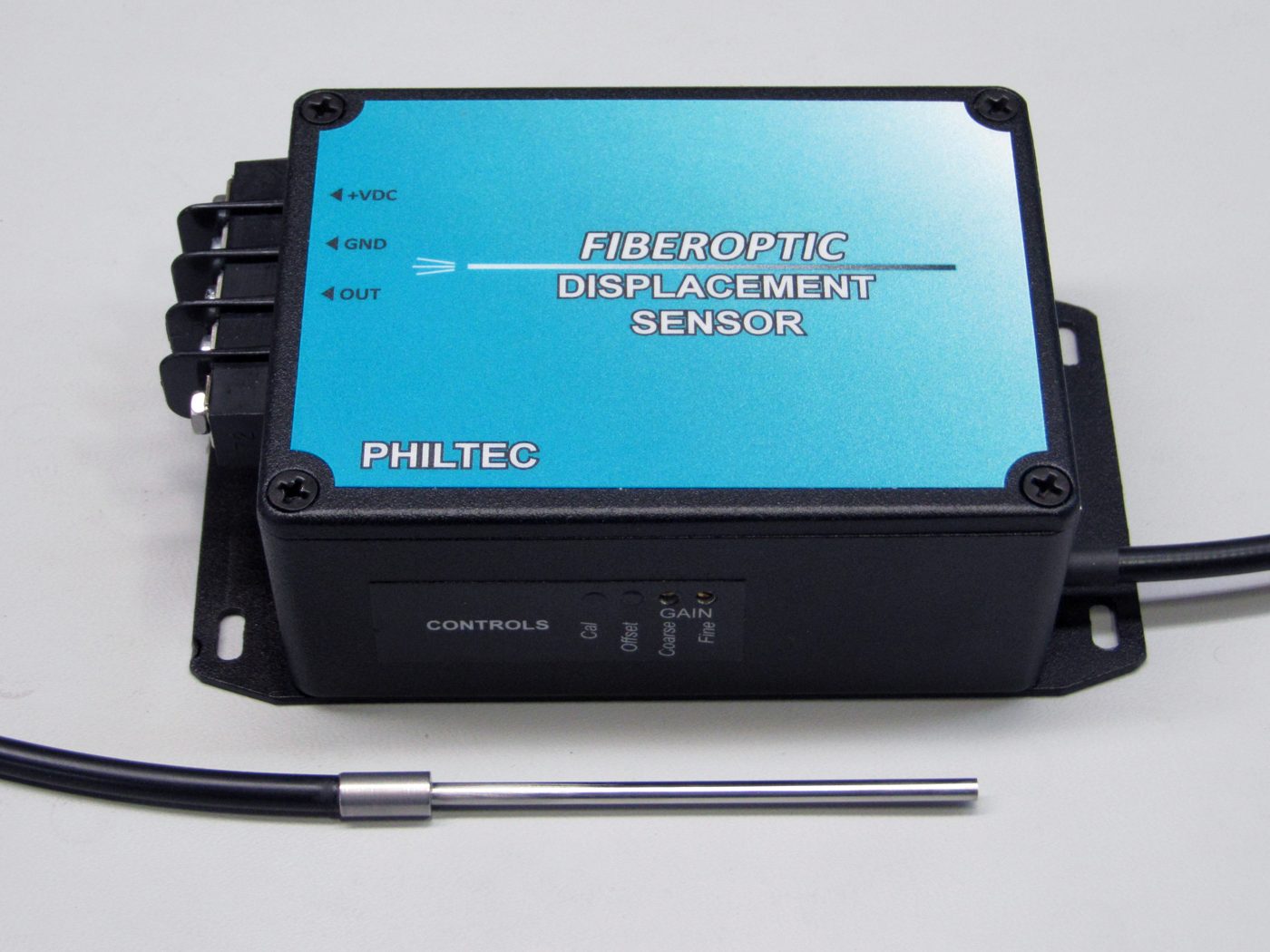

Technical datasheet for the Philtec Model D100 reflectance-dependent analog fiberoptic displacement sensor. Ø 2.54 mm spot size, 10 mm total operating range, and DC–20 kHz bandwidth.
Overview
The Philtec Model D100 is a reflectance-dependent analog fiberoptic sensor for distance, displacement, and vibration of targets larger than Ø 2.54 mm (0.100 inch). Standard single-channel units include the amplifier and sensor tip with a 914 mm (3 foot) fiberoptic cable, require +12 VDC input power (+12 to +24 VDC operating range), and provide a 0 to +5 volt analog output with DC–20 kHz bandwidth.
Output voltage is proportional to both the distance between the sensor tip and target and the reflectivity of the target surface. The Far Side output function starts at the maximum output voltage referred to as the OPTICAL PEAK (set to 5.000 V at factory calibration), and D models are commonly used where target reflectivity stays constant, such as reciprocating or vibratory motion parallel to the axis of the sensor.
- Near side: steep slope rising to the peak as gap increases from contact.
- Optical peak: maximum output voltage set to 5.000 V at factory calibration; gain control calibrates other target surfaces to 5 V.
- Far side: primary calibrated region (0.8 mV/µm or 19 mV/mil nominal sensitivity; 9.6 mm / 0.380 in total range).
Specifications
Standard specifications — D100 Far Side (Analog Output 0–5 Volts)
| Parameter | Metric | Imperial |
|---|---|---|
| Total range | 9.6 mm (10 mm feature) | 0.380 in |
| Linear range* | 2.3 mm | 0.091 in |
| Nominal standoff* | 1.7 mm | 0.068 in |
| Nominal sensitivity* | 0.8 mV/µm | 19 mV/mil |
| Resolution**, DC–200 kHz | 8 µm | 300 µin |
| Resolution**, DC–20 kHz | 4 µm | 150 µin |
| Resolution**, DC–100 Hz | 0.5 µm | 20 µin |
Tip and cable dimensions
| Feature | Metric (mm) | Imperial (inch) |
|---|---|---|
| Tip outer diameter (Ø C) | 3.18 | 0.125 |
| Fiberoptic diameter | 2.54 | 0.100 |
| Tip length (C) | 76.2 | 3 |
| Collar length (B) | 12.7 | 0.5 |
| Collar diameter (Ø B) | 6.35 | 0.25 |
| Cable length (A) | 914 | 36 |
| Cable diameter (Ø A) | 5.7 | 0.225 |
| Cable min. bend radius | 25 | 1 |
Electronics
| Light source | LED, 850 nm |
|---|---|
| Input voltage | +12 to +24 VDC |
| Input current | 125 mA max |
| Bandwidth | DC–20 kHz (3 dB down) standard; DC–200 kHz or higher (up to 2 MHz) and DC–100 Hz optional |
| Isothermal drift | 0.5% |
| Operating temperature | 0 to 70 °C |
| Weight | 0.7 kg (1.5 lb) |
Fiberoptics
| Light beam spread | 30° |
|---|---|
| Tip material | 300 Series SS |
| Tip epoxy outgas | 0.3% @ 200 °C; 2.4% @ 300 °C |
| Tip operating pressure | 15 bar |
| Tip operating temperature | −55 to 200 °C continuous; to 300 °C intermittent (1–2 hours) |
| Cable operating temperature | 10 to 107 °C |
| Cable jacket | PVC over Steel Monocoil |
Nominal standoff is the gap (distance) that places the sensor at the middle of the linear operating range. *Standard specifications provide nominal values only; actual production values may vary by as much as ±15%.
**Resolution figures represent best-case performance where: the target is flat, smooth, and highly reflective; the sensor is perpendicular to the target; the sensor is gapped to its range of highest sensitivity; and fiberoptic cable lengths are standard with an unconnectorized cable.
Response curves
- Linear range, Far Side, ±1%: 0.6 – 3.1 mm (2.3 mm nominal linear range).
- Starts at the 5.000 V optical peak and decreases monotonically across the far side to ~10 mm.
- Linear range, Far Side, ±1%: 0.31 – 0.61 mm; Far Side Y-intercept: 6.709 V.
- Noise ripple @ 3.5 VDC (DC–20 kHz): 6 mV pk-pk.
Distance from the analog output
A calibration chart is provided with each sensor giving the voltage output response to distance. There are three ways to derive accurate distance measurements: (a) within the bounds of the linear range, convert the change in voltage output using Distance = Δ milliVolts ÷ Sensitivity = µm; (b) over the non-linear range, create a lookup table using the XY calibration data points; or (c) use a polynomial curve fit to accurately map the sensor's output function.
Questions
What target size and resolution does the Model D100 cover?
The Model D100 is designed for targets larger than Ø 2.54 mm (0.100 in) with a Ø 2.54 mm target spot size and 10 mm total operating range (9.6 mm / 0.380 in far-side specification). Best-case far-side resolution is 0.5 µm (20 µin) at DC–100 Hz, 4 µm (150 µin) at DC–20 kHz, and 8 µm (300 µin) at DC–200 kHz.
How is in-situ calibration performed on different target surfaces?
Changing target reflectance shifts the voltage output higher or lower. Factory calibrations have the Peak Voltage set to 5.000 V. Adjust the sensor's tip-to-target gap until the optical peak voltage is reached, then use the gain control to set the peak voltage to full scale (5.000 V), after which the factory gap calibration chart applies for that target.
What factory calibration information is provided with each sensor?
Calibration charts are provided for the Far Side region, typically listing the sensor model and serial number, date of calibration, linear sensing range, slope sensitivity, y-intercept of the linear range, and AC noise ripple, with XY calibration data points available upon request.
What bandwidth options are available for dynamic measurements?
DC–20 kHz bandwidth (2-pole Butterworth rolloff, 3 dB down at 20 kHz and flat out to ~6 kHz) is standard. DC–200 kHz or higher (up to 2 MHz) and DC–100 Hz (for best resolution) are optional.
Can the probe tip run hot or under pressure?
The 300-series stainless steel tip is rated from −55 to 200 °C continuous (and up to 300 °C intermittent for 1–2 hours) and up to 15 bar operating pressure, with tip epoxy outgas of 0.3% @ 200 °C and 2.4% @ 300 °C. The cable is rated 10 to 107 °C (PVC over steel monocoil), and the amplifier electronics are rated 0 to 70 °C.